The questions you ask before the first drop-off tell you far more about a dog daycare than a tour ever will. A clean lobby says nothing about how many dogs one handler watches, how play groups are sorted, or what staff do when a dog gets overwhelmed. A well-run facility answers all of that directly and can explain its vaccine and parasite prevention requirements without hesitating. Hedging or a brush-off is information too. The way a place operates is what separates a happy, tired dog from an injury or a shared infection.
Twin Lakes Veterinary Hospital in Orillia handles the medical side of getting your dog ready for daycare. A wellness visit covers the vaccines daycares require, keeps parasite prevention current, and lets us check whether your dog is physically up for a full day of group play. We’ll also talk through whether your dog is mentally ready; group play time isn’t right for every dog, and that’s okay. Our evening appointments Monday through Friday make that visit easier to fit around work. When you are choosing a daycare, request an appointment and we will get your dog's vaccine records in order first.
Before You Book the Trial Day
- The questions you ask before booking are your best filter, and a good facility answers all of them without getting defensive.
- Required vaccines lower the odds of an outbreak, but they don't erase the risk that comes with a group of dogs sharing air, water, and grass.
- Plenty of dogs love group play and plenty don't, and a dog who'd rather nap in a quiet room isn't failing at anything.
- Book the vet visit a week or two ahead rather than the night before, since a fecal test and your dog’s immune system response to a vaccine both take lead time.
What Makes a Dog Daycare a Good One?
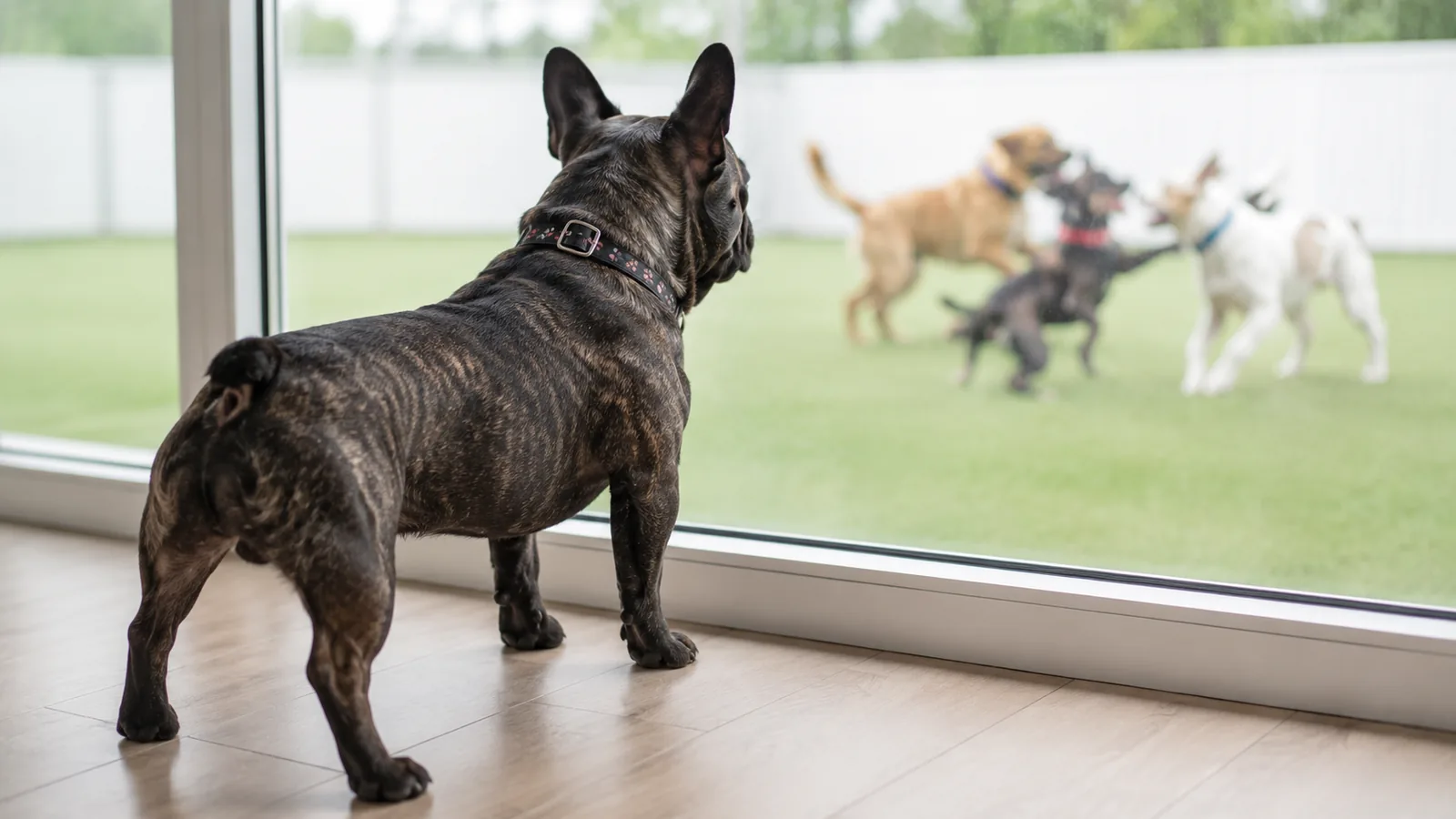
What a well-run daycare offers is structured socialization: dogs learning to read each other, taking their own breaks, and playing to the point of “happy and tired” in a room where a handler steps in before play tips over to a fight.
Quality varies enormously from one building to the next, and what matters happens on the play floor: how many handlers are watching, how dogs get sorted, whether staff can name the early signs of a dog who's had enough, and how the place tells families about a scuffle, a limp, or a skipped meal.
Is Daycare Right for Every Dog?
Group play suits many dogs and leaves others miserable, and neither says anything about how good a dog is. Dog tolerance is not a fixed trait, and a dog who loved a big group at two may want a quieter room at eight, which is a normal shift rather than a behavior problem.
Watch the pickup, not the drop-off. Loose, wiggly bodies and dogs who take their own breaks read very differently from tucked tails, pinned ears, lip licking, and a dog pressed against the gate. Those last few are the canine body language signals that the group has become too much. A dog who comes home pleasantly tired and settles by dinner is telling you it worked. One who comes home wired, sore, or hiding under the bed is asking for something quieter, and a long sniffy walk plus a puzzle feeder covers that beautifully.
If you're weighing a trial day for an anxious or reactive dog, reach out and we'll talk through their history and what the staff should know.
Is Daycare Safer Than the Dog Park?
A well-run daycare screens dogs and supervises play, while a public dog park does neither: nobody checks vaccine records at the gate, nobody screens temperament, and no trained handler is watching for the moment play tips into trouble.
That doesn't put parks off the table. A confident adult dog with a solid recall, at a quiet hour, with someone paying attention, can have a wonderful time. The math changes for a shy dog, a puppy, a senior, or a dog who guards tennis balls. What daycare adds is accountability: someone is responsible for how the day goes.
When Can a Puppy Start Daycare?
Most puppies aren't ready for general daycare until the core vaccination series is finished, usually around 16 weeks or a little after. Their immune systems are still coming online, and a room full of dogs is exactly where parvovirus and kennel cough circulate. Some facilities run separate puppy groups with stricter health rules.
For a puppy group, the questions get sharper. Ask how puppies are grouped by age and size, how long a session runs and whether naps are enforced, how surfaces are cleaned and with what, whether the little ones ever mix with adults, and how many handlers stay in the room. Short days beat long ones. An overtired baby dog learns very little except that group play is overwhelming.
Puppy Classes, Daycare, or the Dog Park?
Puppy socialization has a window that starts closing around 12 to 14 weeks, well before the core vaccine series is finished, so holding a puppy back from every social experience until the last booster costs more than it protects. Structured classes fill that gap with a clean indoor floor, vaccinated classmates of a similar age, and an instructor watching every interaction. Dog parks are the opposite on every count and carry the highest risk for a young pup. Once the series is complete and your puppy has learned to play politely in class, the move to daycare is usually easy.
What Should You Ask About Staff, Supervision, and the Building?
Safe group play comes down to ratios low enough that a handler can watch every dog, groups built by size and play style rather than by whatever door is open, and rest breaks written into the schedule instead of offered only after a dog has already unraveled. The goal isn't zero conflict; it's early intervention.
| What to ask | A good answer sounds like | A red flag sounds like |
| How many dogs per handler? | A specific number that shifts with group energy | "We keep it manageable" |
| How is staff trained? | Body language, de-escalation, first aid, CPR, and ongoing coaching | "Everyone here loves dogs" |
| How do you screen new dogs? | A temperament evaluation plus a short trial day | Anyone can start tomorrow |
| How are groups sorted? | By size, age, and play style, with slow introductions | Everyone plays together |
| What happens when a dog gets stressed? | Named steps: a break, a quiet space, a call home | "That doesn't happen here" |
| Can I see the play area? | A tour or cameras, with honest limits | No access past the lobby |
| When do dogs rest? | Scheduled nap blocks in individual spaces | Play from open to close |
| What if my dog is hurt or sick? | Who calls, which vet, and what gets written down | Vague reassurance |
The building answers questions too. Orillia summers push past 30 degrees C and January sits near \-20 degrees C, so ask how play areas are heated and cooled, who decides when outdoor time gets cut short, and what enrichment looks like on a day nobody goes outside. Ask how toys and food are managed, since guarding starts more fights than personality clashes do. Ask about the flooring, because concrete is hard on joints and slick surfaces cause the sprains we see most.
Flat-faced breeds, seniors, heavy dogs, and any dog with heart or airway disease overheat much faster than the rest of the group. Heavy panting that won't settle, brick-red gums, wobbliness, or vomiting after a hot day needs help right away. Offer cool water and airflow on the drive in, never an ice bath, and bring them straight in for same-day urgent care.
Which Vaccines and Parasite Prevention Do Daycares Require?
Most facilities require DHPP, rabies, and kennel cough (bordetella), and many now add leptospirosis and canine influenza. Ask which ones this daycare requires, how far ahead they need to be given, and how records get verified, because the dog with lapsed paperwork is the risk to every other dog in the room.
| Vaccine | Why daycares ask for it | How often it's required |
| DHPP (distemper, hepatitis, parainfluenza, parvo) | Covers the viruses that do the most damage in a group | Always |
| Rabies | The one no facility anywhere will bend on | Always |
| Bordetella | Blunts the cough that spreads fastest indoors | Nearly always |
| Leptospirosis | Shared yards and standing water are the main route | Common in Ontario |
| Canine influenza | Outbreaks move fast once one dog brings it in | Sometimes, more so after a regional outbreak |
Every dog we care for gets a free rabies vaccine, microchipping, and a nail trim when we spay or neuter, so that requirement is one less thing to sort out.
Vaccines are only half of it. Many intestinal parasites shed in stool that looks completely normal, which is why a fecal test once or twice a year catches what a shared play yard passes around long before a dog acts sick. Year-round heartworm, flea, and tick prevention matters more for a daycare regular than for a backyard-only dog, and most facilities want a couple of symptom-free days before a dog returns after being ill. Most also require dogs over roughly six months to be spayed or neutered, since intact dogs change the chemistry of a play group, and our spay and neuter program can handle that well ahead of a start date.
Which Illnesses Spread in Group Play?
Any room where dogs share air or water bowls and wrestle together will move germs around, and no cleaning schedule changes that completely. Vaccination, steady parasite control, and families who keep a coughing dog home are what keep an outbreak small. Most of what circulates is mild. A few things are not.
- Respiratory: Kennel cough is the one most daycare families meet firsthand, a honking, hacking cough that moves through shared air and shared water bowls, and the vaccine blunts how sick a dog gets without promising they never catch it. Canine influenza looks similar at first and tends to hit harder, with fever and lethargy that don't lift after a few days.
- Environmental: Parvovirus survives in soil and on surfaces for months and shrugs off most ordinary cleaners, so an unvaccinated dog can pick it up from a yard where no sick dog has set foot in weeks. Leptospirosis travels in urine-contaminated water, and a shared outdoor yard with standing puddles after an Ontario rain is exactly the setup that moves it between dogs and, occasionally, to the people handling them.
- Mouth: Oral papillomavirus causes cauliflower-textured warts on the lips and gums of young dogs, spread by direct contact and usually resolving on their own over weeks.
A dog who comes home coughing, off their food, or vomiting deserves a look rather than a wait-and-see week. Request an appointment if something seems off, or come in for same-day urgent care for your dog in Orilla.
What Should You Check After Pickup?
Run your hands over your dog in the parking lot and again at home, covering the ears, neck, shoulders, and the base of the tail, where most daycare scuffles land. You're feeling for heat, swelling, damp patches of saliva, a flinch, and any spot they'd rather you left alone.
Bite wounds do most of their damage below the surface, where a tooth crushes and separates tissue and pushes bacteria deep, so even a puncture the size of a pinhole needs a same-day look. Skip hydrogen peroxide and rubbing alcohol, which damage healing tissue, and never give human pain medication such as ibuprofen or acetaminophen, which are toxic to dogs. Squinting, pawing at the face, or a red weepy eye needs prompt attention, because a corneal scratch from a paw or a stick can look like ordinary conjunctivitis and doesn't wait well.
Shared yards pass parasites and skin conditions around too. Giardia moves easily between dogs drinking from the same bowls and puddles, and it usually announces itself as soft, greasy, foul-smelling stool a few days after a busy week in the group. Ringworm, a fungus rather than a worm, shows up as scaly crusted patches of hair loss and can spread to people. Sarcoptic mange brings sudden frantic itching, often starting at the ear margins and elbows. All three need a veterinary look, and a skin sample under the microscope sorts most of them out quickly, so call us if something looks off after a daycare day.
How Do You Get Your Dog Ready for the First Day?
Handle the medical and logistical pieces a week or two ahead so the trial day is only a test of whether your dog enjoys the group.
Start Short, and Tell the Staff Everything
The best transitions are boring ones. Two hours on day one, a brisk handoff, and no drawn-out goodbye at the door, since a long emotional send-off winds a dog up before they even walk in. Then tell the staff the unflattering parts: the medication schedule, the fear of men in hats, the sore hip, the tennis ball your dog guards at home. Nobody is judging. Handlers who know what's coming can set your dog up to succeed instead of finding out the hard way at 11 a.m.
Your Countdown to the First Day
- Two weeks out: Book the exam, update anything due, and start any preventive that needs lead time.
- One week out: Drop off a stool sample and collect printed vaccine records with dates and our contact information.
- The night before: Trim nails, since long nails cause more scratches on other dogs than teeth do. Feed lightly in the morning, because a full stomach plus hard play is a poor combination.
- At pickup: Expect a tired, thirsty, slightly dusty dog who settles within an hour or two.
What Orillia Dog Families Ask Us About Daycare
How often is too often for daycare?
Two or three days a week works better for most dogs than five. A full day of group play is more tiring than it looks, and dogs who go daily can end up chronically overstimulated, which shows up as a shorter fuse at home, trouble settling in the evening, or hesitation at the door. Stiff, slow mornings after play days are another clue the schedule is heavier than the body wants. Alternating daycare with quieter walk-and-sniff days gives most dogs a better week.
Are minor scratches after daycare a problem?
Surface scratches from nails and roughhousing are common and usually heal fine with clean water and a few days of watching. What needs a closer look is a puncture, a spot that swells or feels warm a day or two later, anything oozing, or a scratch near an eye. Punctures seal over on top and trap bacteria underneath, which is how a pinhole turns into an abscess by the weekend. When you're not sure, have us take a look.
Why doesn't my dog want to go anymore?
A dog who used to bounce out of the car and now plants their feet is telling you something changed. Sometimes it's social: a new dog in the group, a staffing change, or a scuffle nobody mentioned. Sometimes it's physical, and pain is the most commonly missed reason, since a sore hip or an aching ear makes a jostling room miserable. An exam comes first, because that's the piece you can fix. If everything checks out, a shorter day or a smaller group often brings the enthusiasm back.
Choosing the Right Daycare for Your Dog
The right daycare for the right dog is a real gift: a happily exhausted dog, an easier week for a household that works long hours, and staff who know your dog by name. A poor fit shows up as dread at drop-off or an injury nobody explains, and the questions above are how you tell the two apart before you commit.
Twin Lakes Veterinary Hospital takes care of the part you shouldn't have to guess about, whether vaccines and preventives are current and whether your dog's body is ready for the group. Schedule a pre-daycare exam and we'll sort the records and the plan together.